Statcounter

Showing posts with label depression. Show all posts

Monday, February 21, 2022

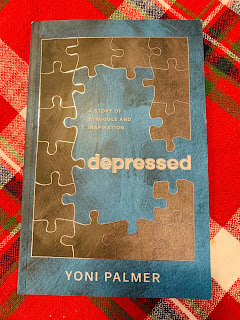
Depressed--a different take on depression, a Jewish point of view

Depressed-by Yoni Palmer, Mosaic Press

 Depressed--a different take on depression, a Jewish point of view.

Well, it isn't so different, not if you are a Jewish, observant psychotherapist, but it is a lovely little book, even wonderful, emphasizing among other things the need (for some of us) to procreate and how devastating it can be when we fail.

If you're a little bit knowledgable of Tanach, those books that follow the Five Books of Moses, you will recognize some of Yoni Palmer's references, especially the story of King Saul in the Book of Samuel (Samuel I). You'll remember noticing, even in that very first reading years ago, that Israel's first king suffered an Axis I disorder--bad. Saul's courtiers did what they could to cheer him up, even brought in a local musician, David. Later the king would chase after David in a paranoid effort to kill him, ultimately killing himself. So out of sorts puts it mildly when we speak of King Shaul.

Anyway.

More of the back story than anyone needs to read. We went to Israel a few weeks ago, had tried to get in much earlier during the pandemic but the country shut its borders to us, fearing contagion would have none of our bringing the disease to Israel. But now that everyone in this tiny country has had covid or been exposed, and many are vaccinated times four, they opened up. And when they did I jumped on a direct flight, ticketed immediately. This before Omicron inserted its viral head into the Israeli calculus. Once the variant took hold the Ministry of Health made people wish they hadn't wanted to return to the homeland--so many hoops to jump through to fly. Then that return flight to the US and a stop in Newark to deplane, retrieve bags, go throught passport control and customs, recheck bags, security again. Why they had to cancel that direct flight no one knows. (Hey, a blog is for venting, am I right?)

It just so happened that our trip coincided with a dedication of stained glass windows in a synagogue. The windows, each depicting a female Jewish heroine, are dedicated to my dear sister-in-law, her memory should be a blessing. She passed away a year ago after a valiant struggle with 4 or 5 different types of cancers. Damn that disease. There, I said it.

At the dedication a favorite cousin of ours handed me a book. Depressed. That's the title. I automatically recoiled. I tend to read either fluffy, funny things, non-fiction (am deep into the Vietnam War right now), or well-written novels. (Sure, sure, I read about neopronouns, too). If a story is about a culture I'm not familiar with, like Native Americans, or people from Asia or Africa, I'll read it cover to cover. These are inevitably sad, but worth the trip.

So when Yoni Palmer hands me a very slim paperback about depression published by Mosaic Press, inside I groan. I feel bad for groaning and hope I am not showing the groan, but in my home there are two full shelves of books on depression, bipolar disorder, and suicide prevention. At least this treatment is light, only 95 pages and will fit right in. 

I read Depressed in one sitting, most pleasantly surprised. It is raw, personal, and insightful. When I ask Yoni what he is doing these days he unapologetically tells me, 'I'm a writer.' How many of us have the guts to say that? I think he also has a day job. 

What I like about his story is not so much his struggle with depression--I've heard twenty thousand of these first hand, I wish this were an exaggeration but people do seek help and they do get better, thank GD. It is Yoni's research into the Talmudic treatment of depression that keeps me in the game. He searches for the 'Jewish take' on the disorder and he finds it. 

I'll sum up that Jewish take with two words: Depression is.

Rather than ignore it or consider depression a weakness or character failure, even some sign of lack of faith, Judaism accepts it--always has. Many say that when we accept what we're feeling, the weight, the burden lightens just a little bit, a sliver. But a sliver, perhaps a shot of serotonin, is good! If we don't accept something we are likely judging it negatively and judging one's self negatively hurts, and it takes a lot of psychic energy--way too much time and energy. This could be one of the reasons depression is so exhausting. Coping with how others judge us, too, takes valuable emotional resources, too much ram. Better to float, sleep, rest, not think. Medicate for awhile. Go to therapy.

You can find Yoni's book here

Winter's almost over friends. Not that we're judging winter, we couldn't possibly diss all that white, black and gray that we see if we look out the window. No, we're good. Right?

P.S. My daughter just sent me this wonderful opinion piece in the Jerusalem Post by Harold Goldmeier, another take on not judging: Jews and suicide

therapydoc


Sunday, March 01, 2009

It's Over

Okay, the reign of terror is over, no more depressing posts for awhile. I have a good one on checking that I can post when I get around to it.

Checking is an anxious habit, one of those symptoms in the anxiety disorder family. Maybe you have this symptom. I check for a lot of things. Like I check to see if every door is locked before I go to sleep, even if I know I locked them. And I'll run home to check to see if I turned off the stove. These are no-brainers. Who wouldn't do this?

So, I'll post on that very soon, and we'll steer away from the sad stuff for awhile, for as long as we can, and keep it a little lighter.

No promises.

Because EVERYONE'S depressed. Everyone I see, either at work or in the community, is depressed.

And they're showing a little anxiety, but not the type you get from too much responsibility. Well, that's not altogether true. The people who are doing the job of three people because two have been laid off are pretty stressed from too much work and responsibility.

But lots of people aren't doing as much anymore, not bringing home the bacon (forgive me) and they're thinking bad thoughts.

The thinking bad thoughts can get you into trouble, you know. Gracie Slick of the Jefferson Airplane said it, in her way, in the sixties. Gracie was lead singer, the song White Rabbit, I think, (who knows if she's still alive). But she advised that you feed your head.

She recommended drugs like LSD, which we now know are bad for you, but the idea of feeding your head isn't all that weird. We really do feed our heads, we do this all the time.

Feeding your head negative thoughts over and over again, basically nourishes a neurological pathway to tears and sadness. And the opposite is true, too. Try the humming, counting and whistling stuff, and you're brain goes to happy. Unless you're really sick and then it won't, and you need stronger stuff, maybe need to see a therapy doc. Certainly don't use LSD.

But if I tell you, It's what you have that matters most, not what you don't have, sure it's a world view, and it's mine, and I go there fifty times a day if necessary. But it's also a way of saying, Don't pave the unhappy pathway. Don't feed your head junk food.

It's what you have, not what you don't have is a mantra, mine, and maybe everyone needs one. The men and women of my mother and father's generation had some kind of saying for every situation, every circumstance.

In English,

Men make plans, G-d laughs.
A good neighbor is better than a distant relative.
A person has to be happy with what he gets in life.

(often there's not much choice, is there, except to feel sorry for yourself, and how boring is that?)

Of course, the mantras of my parents generation were in Yiddish, and everything sounds funnier in Yiddish.

therapydoc

Wednesday, September 17, 2008

Those Appetites

"I hate it when you're depressed," says FD.

"Me, too. But I hate it more when you're depressed."

He smiles. See, everyone gets this way.

Some of us still assess depression times three. "X 3 or times three" means no appetite for food, sex, or sleep. If a person can't eat, has no interest in sex, and can't sleep, we can safely say, Depressed X 3, unless there's another organic reason for those symptoms, maybe a medication that's responsible.

I know, I know, you're going to say that it's also common to do the opposite, have an increase in an appetite for food and/or sleep. And you're right.

Anyway. I had an exhausting day, including a meeting with a new advisory council in the community. It's an advisory council for an agency that educates educators and administrators in the community about a topic that tends to be depressing in general, childhood sexual abuse.

I'm new here (thanks so much, RZ) although not altogether new. When the community zeroed in on a childhood sexual predator several years ago, I helped break down the collective community denial. But I had to quit. When the going got tough, the tired got out.

But RZ got me back in as of a few weeks ago, and I went to my first meeting of dynamic, incredible people who are teaching safety to school and camp administrators, a first step. Teaching the kids, obviously, is the second.

I learned something new, too, about a website for mandated reporters in Chicagoland. It's online training for mandated reporters Virtually everyone working with kids is required to know this stuff in Illinois.

The meeting in the afternoon sort of drains me, as it might drain anyone, but I zip back to work afterwards (I have the car, these things do come in handy now and then) and see a bunch of people.

Home late, feel fine until the phone rings. The call is about an old issue I still haven't resolved, preferring conflict avoidance (who doesn't!). But now someone wants it resolved. It has to be resolved, and it has to be resolved soon. By me. The story, the players, the whole thing is full of spleen and basically knocks me out of the ring for the night. And unfortunately, I can't tell it.

I hang up feeling the worst I've felt in months psychologically, go to bed by nine, something out of the ordinary, with a Robert B. Parker book, Hundred Dollar Baby.

If you know Robert B. Parker, he writes page after page with dialog on the order of this:
"How can you eat tongue," Corsetti said.
"You know how intrepid I am."
"Oh, yeah, I forgot that for a minute."
"You make first yet?" I said.
"Detective First Grade?" Corsetti said. "You got a better chance of making it than I have."
"And I'm not even a cop anymore," I said.
"Exactly," Corsetti said.
The coffee came. Corsetti put about six spoonfuls of sugar in his and stirred noisily.
"Is it because you annoy a lot of people?" I said.
How hard is it to concentrate on this? (One Hundred Dollar Baby is about prostitution, by the way, or is it better to say Escort Services or even Sex Workers).

FD comes home late and I tell him about the new old issue and he tries to help me work it out, but he can't. Not really. None of his thoughts on the problem work for me, and my thoughts don't work, either. But it's comforting knowing he's got my back.

Sometimes when you're problem solving you have to accept that there may not be a good imminent solution. Sometimes the answer has to be to accept the problem for what it is, something annoying and stuck.

Except that I never really accept things as unresolvable. I'm in the profession of resolving.

Death I get. That I can accept. Illness, too, but not always. Other stuff? There has to be a way.

But, no matter how many heads you put together, just because you want to solve something doesn't mean it's going to happen. Like the problem of sexual abuse in a community. There we are, twenty-some smart people, no where near solving the problem. But we're closer to something of an answer now than we were ten years ago.

So I sleep on it, wait awhile, brainstorm again, mostly in my own head. Until something's right you're in no man's land, just feeling badly. But you rock on anyway.

Morning comes and FD's pushing breakfast on me and I'm gently saying No since it's only been a few hours since that feeling of probably never eating again. That's when he says, "I hate when you're depressed."

Technically the crisis is only 10 hours old. And it's not like I'm grousing or complaining or anything, either.

He lets it go, warms up a muffin, splits it, takes half, leaves the other for me. I snub it, go upstairs, do a little paper work, take a nap. I didn't sleep well the night before.

Before I blink it's 11:00 and I've got to go to work. I'm staring in the mirror wondering how to improve what I see when I hit upon a solution to the crisis. A quick and dirty, perfect solution, if only temporary. I feel a little better, jump into my biking clothes and pack up to leave.

But first I stop in the kitchen, wrap up the muffin. FD sees me. He's scavenging in the cupboard.

"I'm thinking PBJ, on rye. Not toasted. Marmalade." I say, "To Go."

"A fine choice," he agrees.

therapydoc

P.S. Now if we could only think up something for those guys on Wall Street, right?

Tuesday, September 18, 2007

Owen Wilson's Suicide Attempt

You know that on occasion I get the skinny on Hollywood gossip, right? But keep in mind that my mother-in-law says that her mother used to say, Believe half of what you hear.

So believe half of this.

On Sunday the National Enquirer ran a story that Owen Wilson had cut his wrist and was hospitalized, cocaine in his system.

Then on Monday, Dafne Merkin wrote a piece in the New York Times Magazine (Darkness Invisible) and asked rhetorically:

In a culture that encourages outing everything from incest to pedophilia, is depression the last stigma, the one remaining subject that dares not gossip its name? Does a disclosure about depression, especially from someone who seems to have it all, violate an unspoken code of silence — or, at the least, make us radically uncomfortable with its suggestion of a blithe public face masking a troubled inner life?

She asks that question because the word on the street in Hollywood is that Mr. Wilson really didn't try to kill himself. We are to believe that he is a heroin addict who accidentally overdosed.

And it is his family that wants us to believe this. Rather than expose him as suffering from depression his whole life, the family told the press to spread the word about his "addiction."

Remember, I'm just spreading gossip here, but if it's true, and let's just say for the sake of argument that it is, then the poor guy isn't even granted the right to communicate cogently about his preferred final communication.

NOW THERE'S A POWERFUL FAMILY SYSTEM.

If it's true.

And I believe it's half true, the powerful family system part for sure.

Ms. Merkin's piece is written from experience, and is a poignant reminder that although we romanticize depression, it is far from sexy, and our culture respects, perhaps even admires the risky, self-destructive abuse of illicit drugs. Hurting one's self to get high is sexy, exciting.

Battling negative emotions is not.

As FD says, It is still considered a weakness to be depressed, especially for a macho guy like Owen Wilson who plays cowboy roles. It's bad for the career to be weak, as in paralyzed with sadness.

Apparently depression is stigmatic, but heroin addiction is IN. We're still not bored with celebrity rehab. The thought of Paris Hilton, Lindsay Lohan, Owen Wilsons (!?!#) getting stoned out of their gourds still turns us on.

Addiction's hot. Depression's well . . depressing.

Now, as a therapy doc, I have to tell you that indeed, addiction is not sexy. It is life threatening, no question and most people who have substance dependencies do not want them. The dual-diagnosed, those who suffer from both depression AND drug or alcohol dependency, aren't whistling Dixie, either.

I'm a little worried, frankly, that Hollywood makes out that it is cool to be a drug addict. The message to kids who are already looking to self-medicate for depression is, Get illegal drugs. You'll feel better and you'll be Cool.

Anti-depressants are for losers.*

Mr. Wilson? If you're out there? I hope you get well. Keep at it, for the sake of your talent. You make us happy when you're on screen.

And when you're well, tell the world exactly how hard it is to beat depression, but tell them that it's worth the fight. It is harder to beat depression and much more macho, than it is to use heroin. The fight against depression is positively heroic.

Be our hero, Owen. Take it on. You're in good company.

*FYI, I just read something (WSJ, not a real science journal) about current higher suicide rates for teenage girls associated with lower pharmaceutical prescriptions in that age group for antidepressants.

No kidding.

Shaking my head with confusion,

therapydoc

Wednesday, May 16, 2007

Courage

There are perks to this job.

No, not to being a therapist. No perks there, in fact, many disincentives. For example I'd be sitting at an affair, maybe a dinner or a birthday party, and someone would ask

Do you work outside the home?

I'd say

Why yes, I sell flowers. I have a little shop in Glendale (a nonexistent 'burb in Chicago.)

I used to do that because after I'd tell people I was a therapist it was all about me. What kind of therapist are you? What kind of patients do you see? What kind of problems do you see the most? And oh, by the way, can I ask you a question about . . .

It's like my brother, the dermatologist. He can't sit down in a restaurant without someone stopping by the table and lifting up his shirt to show him a dot. What do ya' think it is, doc?

Still, although the perks of being a therapy doc at a wedding or a Bar Mitzvah are few and far between, being a therapy doc blogger is awesome.

You get free books. Who knew?

Email:
Hi,

My name is A. and I work for Sourcebooks, Inc, the publisher of the book Extraordinary Comebacks: 201 Inspiring Stories of Courage, Triumph, and Success by John A. Sarkett. I was hoping you would be willing to review this book for your blog.
The publicist goes on with a list of reviews and explains that there is no obligation to blog about the book if I read it. She continues:
AND, it's always nice to get free stuff.
Maybe she knows about the cool pens the drug companies give F.D.
Other docs get trips to Bermuda. He gets pens.
Oh, and I need more stuff.

Sure, I'll do it.

The book came in the mail the following Friday and I tossed it onto a pile of stuff I read. It's a big pile. I'm always embarrassed when I add to it. What if someone walks into my bedroom and sees this pile of stuff on the floor? Newspapers, journals, books, magazines. A complete disarray. What will they think? What a slob.

Anyway, there's a half inch banner across the cover of the book. It's not the best cover, honest, I wish they'd have hired my kid to do the art work, but okay. The banner says,
ADVANCE READING COPY. NOT FOR SALE.
Now that impressed me. I don't know why. Maybe I felt like I was in a special club. At some point I picked up the book and read John Sarkett's introduction, which was a little wordy and corny. I tossed the book back to the pile.

But I felt GUILTY. I'd said I'd take a look. They spent money on the postage. Reading the introduction wasn't much of a look.

So I did the chesbon (Hebrew word, sounds like hesh-bone, means accounting) and said to myself, There are 201 2-3 page stories about famous people in this book. Maybe I'll learn something cool, something I can tell over at a wedding or a bar mitzvah.

And I DID learn cool things.

Like, did you know that the Julie Andrews had a throat surgery and it went so badly that she doesn't sing anymore?

But she went on to make the Princess Diary movies and who doesn't love the Princess Diary movies?!

Or did you know that Pablo Picasso was depressed over his friend Carles Casagemes' suicide and THAT'S why he was blue during his blue period? This is why, peops, I keep telling you to use your emotion as an advantage, not a liability. Being sad can inspire creativity. Look at Picasso.

Or did you know that Michael Jordan didn't make the cut for his high school basketball team?

Or that Ray Kroc started out selling paper cups and moonlighted as a jazz pianist? (F.D., there's hope for you, honey).

Or that CBS originally said NO to Lucille Ball's idea of a sitcom called I Love Lucy?

Or that Stephen King nearly died in an auto accident and thought he'd never write again?

Wow, 201 stories like this. I started reading algorithmically in my obsessive-compulsive way, before I realized I could skip to the very end if I wanted to and STILL write this review! And no one would know!

Okay, truth be told. The book is a great social lubricant. I brought it to the dining room table and read a few stories to F.D. last Saturday. We were entertained, enjoyed the stories quite a bit. But then, we're easy on a Saturday afternoon. An article in Commentary or National Geographic would make us laugh.

The publicist wrote that I might want to recommend Extraordinary Comebacks because it's inspiring.
You know how hard it is for people to see the light at the end of the tunnel, she wrote.
But this book won't necessarily help anyone see their light at the end of the tunnel. I think it could even have that paradoxical effect of making depressed people even more depressed.

Why was HE able to be so successful and I'm such a sjhlub? (sjhlub is untranslatable; a close translation would be slob).

Inspiring stories, tributes to the human spirit, Extraordinary Comebacks is chock full of them. And for that, perhaps worth the price.

But this is what we in the therapy doc business call anecdotal data. That means for every 201 extraordinary comeback stories, there are a few million less extraordinary comebacks and many stories about people who are not coming back at all. Those quiet lives of desperation.

Most of us are not going to be like these 201 exceptionally talented people who rose up against mental and physical disability, financial loss, and Himalayan darkness.

Our saving grace is just being thankful, thankful that we're able to open one eye then the other in the morning and say, I'm BACK. Another day. Another chance.

Or simply, UGH. Still a comeback of sorts.

Now that may seem depressing. But you should know. When a therapy doc taps into your particular hidden talents, the ones you've shared with a person like me? When you and I talk in secret and the real you comes out, and I suggest that perhaps you really can beat those odds; I mean, who knows, I'll ask, who really knows what those odds are, whether or not, if you try, you might rise above the grain.

When we talk about you quitting that job, or investing LESS emotional/ physical energy/time in the job that's making you sicker day by day, and you consider working harder at your other strong suits, well,

Well, you usually laugh.
Oh, I could never do THAT, you tell me.

Write the book, I say. Start a band and play the gig. Borrow money, start a business. Adopt a child. Get vocational counseling. Charge more for what you're doing. Go back to college. Paint. Travel. Consult. Sell your work.

You shrug and tell me you could never do that, you're too old. Or you're too tired.

But I have to tell you. When we do hit on that talent, that latent aspiration? Even though you poo poo me and say you could never do it, even though you dismiss it all as pie in the sky and maybe, indeed, that is all it is,

You really do look up for a minute.

You get that glint in the eye, that tiny glimmer of, Well, it's true, I am a good. . .

You KNOW you've got it. I mean, maybe, just maybe, we're not all that different than the 201 people in John Sarkett's book. Maybe with just a little bit of luck. . .

That's why, I for one, LIKE anecdotal data.

Copyright, 2007, therapydoc

Tuesday, March 27, 2007

Head spin

That story in WSJ on Chuck Mahoney did that, triggered me, maybe it triggered some of you, too. For me it was less the outrage about nobody saving Chuck's life than it was the sadness I felt for his parents and his brother. Elizabeth Bernstein wrote:
About once a week, the elder Mr. Mahoney opens the closet and buries his head in a sweatshirt that belonged to his son, trying to detect the fading scent.
I read the story on Saturday, looked up from my newspaper, stared through an open window to the backyard and tranced back over thirty years ago, saw myself putting on my brother's clothes, picking out a jacket (way too big for me), burying my head in it. My mother found me and I turned to her, This is mine, okay?

I almost started my post (3-24-07) on Chuck Mahoney like this: If you're easily triggered, meaning if you get depressed and stay depressed for a long time and can't bring yourself out of it, YOU MIGHT NOT WANT TO READ THIS.

So Elizabeth Bernstein's article made me. . . pause. For quite awhile. A good four hours, and my brother didn't kill himself. Journalists can do that to you. This blog is journalistic in that way too, sometimes. Maybe now.

Emotionally manipulative-- intentionally. I'll let you in on a little secret. You already know it, probably. Feeling badly for most of us, soaking up a little sadness, relating to the pain of others or even feeling our very own pain isn't so bad. In fact, it's a good stretch. Almost sublime. Expands our sensory perception of reality.

In my world view if a day goes by and I haven't squirted out at least one tear then I've been out of touch with reality, the suffering around me. It's around you, too, of course.

There are triggers and there are triggers, and there are the triggered and there are the triggered. My warning on that post would have been to those individuals who wouldn't bounce back within the hour or the day. The warning would have been for people who could really lose their cognitive functioning and maybe wouldn't be able to work for a couple of days after that. It can happen.

Being unable to function when depressed means there's no capacity to think. That's why making decisions is so hard. When a person can't "think straight" then there can be an added feeling of panic. That's why you'll sometimes describe to me waking up with a horrific fear, crippling fear mixed with tears and sadness, all interwoven at the same time, severe, severe panic and pain. And you haven't even started your day! You haven't brushed your teeth yet!

Not a nice disorder, depression.

So therapydocs tell people who suffer from it to avoid triggers. Although in some types of depression (probably the severe one I just described above) triggers may have nothing whatsoever to do with the onset, meaning an episode can seemingly come from out of the air.

Bi-polar disorder can be this way, although bi-polars can be triggered too. They will usually cycle, however, and there are seasons and months that are more likely to be more severe in one direction or another. They jump around on the continuum below in every which way with no say so in the matter. Usually it's physiology is all.Sometimes that depression on the left can hit like a ton of bricks with no warning.

For most other types of depression, however, like adjustment disorders, the onset is a little slower, and things do get gradually more and more gray and horrible.

We tell patients recovering from depressions of all kinds to avoid stimuli that they know will make them sad, the thoughts that will stick with them, affect their thinking, send them back down again.

Here's my short list of how to avoid triggers that can either cause an episode or make it difficult to recover:
don't read the newspaper
don't watch t.v. (unless you're sure it's comedy)
don't follow the war
don't go to funerals or wakes unless you KNOW you'll be okay
don't talk to people who upset you
that might mean, don't answer the phone or the doorbell
do protect yourself from stress of all kinds
do try to live in a bubble (although you can't, really, but try)
do make your own emotionally safe, restful environment (don't accept visitors, don't do extra community work to make people happy until you're really better)

that's basically what being in the hospital is like, you know, protective


And of course, my advice is based upon empirical data vis a vis the things that trigger psychotic reactions Let's segue there because it's so interesting.

The psychotic fear, depression and paranoia of schizophrenia and schizo-affective disorder can be triggered by something called expressed emotion.

Expressed emotion is really anger/criticism expressed at anyone at all by anyone within the family or on the job. Families who have a member who suffers from schizophrenia are taught to keep the anger and the criticism, ANY anger/criticism to anyone to a minimum.

Best to lose it entirely from the family's range of emotions.

That's the best thing you can do for a mentally ill person in your family. Be really gentle and nice all of the time. That will reduce your vulnerable family member's screaming anxiety and depressive outbursts.

Now. I think we could take a leap, here. Maybe, just maybe, if anger and criticism are bad for people with severe mental disorders, then perhaps they're also bad for the rest of us?

Hmmm.


Copyright 2007, TherapyDoc

Thursday, October 12, 2006

Depression Varies

I wrote the last post to give you a little perspective on depression. Most of us are depressed at some point during the day, and we’re quite conscious of it. We KNOW we’re depressed.

Friend One: How are you?

Friend Two: Depressed, you?

Friend One: SO depressed.

Friend Two: Yeah.

But you should know, after reading the last post, that you might not actually be suffering from depression. That post was a welcome to my world, post. It's the kind of depression I hear about all the time, the reason you don't want my job, right?).

What I wrote about was clinical depression, that it really has to be treated with medication and psychotherapy. The only thing that can kill you about depression is you. So we take it pretty seriously in the biz.

The DAILY feeling of depression can sometimes be diagnosable as well. (Okay, everybody happy? Maybe you are depressed).

In any case, another real McCoy diagnosis, Dysthymic Disorder, is a state of being depressed MOST days of the week, most of the time. You can be dysthymic and still have no trouble getting out of bed. Your thoughts don’t have to be that dark. But you're sick.

Most of us, however, are stuck with feeling low, probably a function of blood sugar (that’s why your mom said, EAT), fatigue, lousy luck, social problems, a difficult work situation, or, or course, no work situation. LOTS of reasons.

If we watch our emotions we can actually track how fast they change. But if you find yourself tracking your emotions you might actually be depressed. Maybe you don’t have a major affective disorder, but you can still benefit from a little psychotherapy, or better still, some relationship therapy if you think you need it.

There are many different actual clinical diagnoses of depression, but being turned inward, being hypersensitive to your body and emotions, is symptomatic of all of them

If your physician tells you that you’re somaticizing, then he/she is referring to something a little different. Your body can take on symptoms of real illnesses when you’re depressed. Your medical doc can treat the illness, but you really need to talk about your problems to get to the source.

Sometimes you get sick when you’re depressed because you’re not sleeping well and your resistance is low. Case in point for naps (or meds).

At the end of the day? It doesn’t matter what the clinical diagnosis. Follow your symptoms, and if you feel you need to talk to someone about them, do it.

No point in being macho about depression when we KNOW it’s the one illness that we can cure. (see previous post, Depression Feeds on Itself)

Copyright 2006, TherapyDoc

Tuesday, September 26, 2006

The Sunny Side of Therapy :) :) : ) :) Positive Psychology

This is an FYO on a popular news item in today's Wall Street Journal.

There's a feature story called, "The Sunny Side of Therapy." It's about focusing only on the positive, a person's true resources, strengths, etc. I was surprised the article didn't refer to "blessings."

Now you know I'm a pretty positive person, but I just have to tell you.
This is bunk with a capital B.

It's all well and good to try to stay there, to try to stay happy and to think pleasant thoughts. I heartily recommend it and in family therapy whack bubble bursters over the head with a newspaper (WSJ?).

But when a person is suffering from depression or any of the disorders in the DSM-IV, for that matter, it's going to take a lot more than positive psychology to get well.

Positive psychology is nothing new. Therapy docs have been relabeling problems for years, ever since family therapists (plug, here) found that symptoms were functional for people. People like their symptoms. They not only get attention for them, but they communicate with them.

Even support for "everything's relative" has been around for decades. Broke your ankle? At least you didn't break both. (thanks Y.)

It's actually good to pick yourself up, brush yourself off, and start all over again. Once you can.

Real therapy, good therapy gets in there and resets the bones, cleans out the infection. It requires a little more than applying a Band-Aid.

Those snake oil salesmen made it all up to advertise in the Journal.

There. I've said it. Have a happy day!

Copyright 2006, TherapyDoc

Wednesday, June 28, 2006

POT

This is less about self-medicating with marijuana than it is about how complicated and unmanageable emotions can be. One day it's depression, the next day anxiety; one day we're manic, the next day obsessive-compulsive. We get the symptom of the week, too, whatever we read about on the Internet, hear about on Oprah. We’re complicated organisms, humans.

This conversation isn’t fiction, I’ve had it many, many times.

PATIENT: I don’t know, doc. I’m feeling pretty down, pretty sad. And summer’s my happy season. This is going on for too long. I lost my job. Life sucks.

THERAPY DOC: (At the risk of sounding trite, stroking chin). How long would you say you've been feeling like this?

PATIENT: I don't know. Maybe three months, maybe more.

THERAPY DOC: Sad.

PATIENT: Yeah. I'm depressed. Everyone's noticed, too.

THERAPY DOC: Excuse me. But I thought that on the phone you said you wanted help with an anxiety disorder. You don’t look or sound very anxious at all.

PATIENT: Well, I've had anxiety my whole life. Panic attacks, obsessive thoughts. I'm a high strung person. If I get depressed it's because of something bad happening, something situational. Like I know I'll be fine when I get a job. Getting laid off really hurt my pride. Talking in therapy like this has helped me before, but the truth is that nothing's ever really stopped the anxiety thing, so that was why I said I had an anxiety disorder when I called.

THERAPY DOC (wondering if there are co-existing disorders, two Axis I disorders, maybe a personality disorder, too): So what do you want to work on?

PATIENT: I’d say the depression right now.

THERAPY DOC: And you say you’re not taking any prescription meds?

PATIENT: Right.

THERAPY DOC: Are you drinking alcohol or taking any street drugs?

PATIENT: Oh, I smoke pot every day and drink a little, not much.

THERAPY DOC: All right, so at the risk of you never coming back here again I'm going to recommend that you stop the pot completely for a couple of months at least, go for four months. The pot’s depressing your brain. And the alcohol does the same thing, by the way.

PATIENT: No way. If I stop smoking pot then I’ll get my anxiety back.

THERAPY DOC: So we’ll work on it with some behavioral therapy, some self-relaxation exercises. If you want, we can start you on decent legal psychotropic medication for anxiety, too. We have better drugs for this kind of thing. It’s likely that the marijuana and alcohol are working against you, not for you. Take a holiday from it. It's garbage.

PATIENT: Okay, I can try, but I’m going to be a nervous wreck. I've been smoking for a long time.

THERAPY DOC: But it's killing you.

PATIENT: Not really. It calms me down.

THERAPY DOC: Did you ever try an self-relaxation?

PATIENT: Not really, a little yoga once.

THERAPY DOC: Yoga is great. What did you learn?

PATIENT: I don’t remember, stretching, mostly.

THERAPY DOC: Before you reach for a joint, do that, get down on the floor and stretch for fifteen minutes. This is harder than you think, but do it. Then try some other distraction before the toke.

PATIENT: I’ll try. But I have these feelings all the time.

THERAPY DOC: Which is why you need more portable strategies to regulate your anxiety. That’s the problem right now, so that’s what we’ll treat right now, since you told me you don’t want to spend the time going over childhood issues.

PATIENT: Right, what’s the point?

THERAPY DOC: If you have the time, that life review thing can feel very, very good. But okay. Today you’re just needing something to depend upon other than sucking down poison, and smoking pot, so I’ll teach you a quick muscle-relaxation exercise. Would you like that?

PATIENT: I believe I have no choice.

THERAPY DOC: Not if you want to be happy if you reach retirement age. If you want to be an old drug addict, you can make that happen, too.

PATIENT: Uh, I don’t think that’s what I want.

THERAPY DOC: Grab a couple of thick markers and squeeze the hell out of them until your biceps quiver. Can you do that? Let me demonstrate. (I demonstrate, offer markers to the patient). You can do this by just making a fist and squeezing it, behind your back if you like in public. It’s not so easy if your nails are long. You can squeeze any part of your body. Getting yourself into a push-up position, for example, and not doing the push-up, just holding it, makes those muscles shake quite nicely, or leaning on your hands in that position standing against a wall. Oh, and get out and walk, run, exercise. This shakes off some of the anxiety, too, wakes up the serotonin in the brain, shakes it out of the walls of the neurons in your brain. We don’t call it runner’s high for nothing. Play basketball, tennis. DANCE!

.
People do much better with these kinds of interventions than they do getting stoned, crazy though it may sound. Not a cure-all for everyone, certainly, but eliminating the downer, the pot or the alcohol, substances that serve as depressants to the central nervous system, surely helps the depression.

A good evaluation by a therapist, and a psychiatrist, too, sometimes, saves you a lot of money on the street. And you might lose a lot of weight, too.

therapydoc

Transitions

   Rabbi Zev o nce  told us that a rabbi, a Jew, has to be ready to go to a funeral and then a wedding  on the same day, maybe within a few ...