Statcounter

Wednesday, November 16, 2022

Preying Mantis, Child Abuse, Child Sexual Assault


No, that's not a typo in the title

It’s a lazy, cold, rainy morning and I’m catching up on Facebook, wondering if there’s an actual date that the world will melt from global warming or some similar event to spoil my Zen. Masochistic, I know. But Donald is running in 2024! People in power, more than one, are outed for sexually abusing children. Oh, that works. 

But wait. Before getting to anything substantial, maybe in lieu of getting to anything substantial, let’s play a game! A language game. 


Is child sexual abuse the same as child sexual assault


When it comes to kids people are always using the word abuse as in child abuse, but in my studies of sexual assault, and there were several years devoted to this, I learned that no matter the spot on the continuum from molestation to rape, or even murder before or after the rape, it is the legal word assault that we use. So why, if we are talking about kids, is it abuse that gets prime time? Nobody says, A child was sexually assaulted in a classroom. They say, there’s a case of child sexual abuse in such and such a school. Just an example, apropos of nothing. Let’s look a little deeper.


I was not even sure what abuse meant so I Googled it and found the definition of abuse to be improper treatment. Abuse is softer, it is code for assault, less in your face.  


By this definition we might say that abuse is what happens while I am behind the wheel of a car with a manual transmission. I will abuse the clutch. You can count on it. The clutch is likely to be an ex-clutch when I get through with it but it isn’t something intentionally cruel, I don’t mean it, I do not set out to wreck the clutch or its future. 


Abuse might also be applied to shoes, or linens, too. You wear a pair of suede shoes out in the rain. Or you take a tablecloth, one that should have been dry-cleaned, and throw it in the wash. Textile abuse. Always accidental but the consequences are lasting. 


But you see, nobody cares if I ruin my shoes. Nobody cares about my table cloth, except maybe my mother and she is in Heaven. In Heaven there must be better things to do. Perhaps golf.


Assault, on the other hand, implies more energy, more intention, even violence. It is what I’ve done to more than one cockroach. I admit to assaulting small, defenseless creatures, midges, flies, mosquitoes. Maybe a spider or two. This points to a severe empathy deficit when it comes to insects. Is the deficit genetic or learned? It is learned, for sure. This one is learned. I suffered a trauma and I need to talk about it. Talking about trauma can be therapeutic. It is can be exposure therapy.


A Relevant Story About the Praying Mantis


Once I loved these insects—so elegant, so delicate, filigree green—until on a summer night at the pool, about to hop in, I see a praying mantis merrily prancing in the water. The green sticklike creature is hopping up onto the blue and white plastic rope cordoning off the lap lane. Not believing my eyes and good fortune, because again, I had once loved these insects and had never seen one in a swimming pool, I jump in to get a closer look. 


A correct call! This is a mantis pacing back and forth on a plastic rope. I watch for a bit then swim a few laps, checking once or twice to see if it is still there. At one point I stop to observe, stand up for a better view. Within seconds the mantis’ persona seems to change. The creature appears to be summoning up insect serotonin, readying itself for an attack. Posture forward, legs in front. No longer praying. 


Stunned, I do not move. Why this sudden confrontation, I wonder? Perhaps it thinks I invaded its  space, turf. He, she, they got there first. (Let’s go with she). I’m not usually in the pool after dark. Or maybe this evolved creature, clearly a favorite of the Old Mighty by design, feels objectified. I had been watching, admiring. She jumps back in, treads water a moment while glaring at me, bug-eyed, threatening.  


I’m about four feet away. We have a little staring contest for a few confusing seconds before she makes her move, darts at me, paddling at top speed! True story! I back off, swim away fast, terrified, and when I look back, she is gone.


The moral of the story? 


Do not trust all insects, especially if they feign to be religious. 


Game over. 


There is more to be said about why child sexual assault within schools tends to be washed, bleached, softened as child abuse or even no abuse at all. So this subject is 


To be continued.


therapydoc


T

Sunday, October 23, 2022

Must Everything Be Said? Unsolicited Criticism

 Must Everything Be Said? Unsolicited Criticism

Of course not, we all know that. 


This one should come after the post on Asking Personal Questions, but life got in the way. 

The Proverbial Knife to the Heart


When we have what we think is an intimate, close relationship and it isn't based on anything except shared background, let's just say we're talking about extended family, we might feel that the boundary that ordinarily gives us pause isn't there, that it doesn’t need to be.


But if you tear down a fence you’re likely to trespass.


We're thinking: family. This is how families interact. They simply say what they think to one another. But really, that isn’t how healthy families interact. In a healthy family members are careful about what we say to one another, and how they say it. That may seem obvious to some, but if it were that obvious family therapists would be out of work. 


The most common violence id domestic. It occurs in the family. It is filed under Domestic Abuse in the therapydoc dictionary. 


Because cousins, let's just say, have known one another since childhood, because some of their more interesting adventures started in one another's homes on Sundays or on Thanksgivings, there can be a sense that what happened then, who we happened to be then, is open to discussion, as if it still represents who we are today. 


Cousins are in on secrets. They have proprietary knowledge. Nobody can shame us like our family. It is one of the reasons so many families 'break up.' 


I have a cousin who had a very close relationship with his mother. His mother had a close relationship with my mother. My mother confided in my aunt and my aunt surely shared her secrets, many of them, with my cousin. 


Would we call that enmeshment, even emotional incest?

I would. 


But more to the point, does this mean my cousin thinks he knows me? He knows what makes me tick? I think it does. He behaves this way, seems to feel he has the right to be honest with me, to tell me  what he thinks about, say, a personal choice I have made, maybe how I dress. 


We would call that unsolicited criticism. Who wants that


No one wants that. 


So, have I told him off when it has happened, when I have born the brunt of too much honesty? 


I have not. I don’t feel close enough. I’m afraid it might hurt his feelings. He definitely doesn't see his criticism as inappropriate. How do I tell him it is? Well, I could just say: I don't think I asked for your opinion. That's a good line. 


Looking into why I can totally coach other people in these situations, yet can't take my own advice, I have to do some soul searching. 


I think: 


(1) It might impact the future of our relationship and there aren’t too many of us first cousins. But actually there are. 


(2) I’m a conflict avoider in general, prefer him to think we are close, brother and sister. It is what our parents would have wanted. It is what WE want.


(3) When the time is right maybe I will tell him I don’t appreciate his opinions when they are negative. But I don't want to pick the wrong time. The wrong time is when a person is still upset about something. That's not the right time to have an intellectual conversation. 


(4) I׳m codependent. A people pleaser. Need to  be liked. He won't like me if I make a big deal about 'nothing.' Maybe. 


But I have to think about my mother and what she would say (my cousin also thinks he 'gets' my mother, but he doesn’t. My mother would use an expression, Shalom bayit, keep the peace in the home, in the family. She loved peace. It’s cheap, you know. All you have to do is keep your mouth shut. 


Plus I know that one day I’ll find a good place for the conversation. It will happen. 


We could stop right here and say that the moral of the story is that pseudo-intimacy, not rocking the boat to sustain a relationship, no matter how many years you have had a particular relationship, is good. Or at least not the worst thing. 


BUT THE BETTER SOLUTION TO THIS PROBLEM OF UNSOLICITED ADVICE/CRITICISM IS AS FOLLOWS


What I should do is what I tall patients to do. This is what you do, friends, when someone hurts your feelings.


a) You pretend that they just stuck a knife into your heart. (It's on the left side of your chest.


b) Then you wince and dramatically grab the imaginary knife in your right fist. You take great pains to pull it out of your heart, your right arm making a very wide arc, a broad stroke until your fist is horizontal to your body. 


c) Then you drop the knife to the ground. 


d) THEN you fall down and pretend to be dead, eyes closed. 


e) You open one eye and say, 'Ya got me. That hurt.'


Should have done that! Something tells me I'll get another chance.


therapydoc

Tuesday, October 18, 2022

Turkish Air and My Implicit Bias

TURKISH AIR


 Definitely a better priced trip. On time, a good deal, and no luggage lost. At least not yet. 


So I think I told you I’d be leaving on a jet plane. That happened, and it was fine. Jet lag, which didn’t affect me much my last trip, is murder only eight months later. I don’t even want to tell you how many time zones we skipped in a matter of 24 hours. 


One of the things that happened on the way over provides us with a good example of IMPLICIT BIAS. Mine. My implicit bias. It isn’t something I’m proud of, but like anyone who takes the standardized test on racism, the Banaji-GreenwaldImplicit Association Test (IAT), I fail miserable at beneficence. Turns out I prefer white people, which feels wrong but the test is standardized and I believe the results are valid. The best I can aspire to is cultural humility, which refers to knowing how little we know about others, respecting the differences, recognizing that we share 98% of our DNA regardless of socialization. Humility is respect for difference, acknowledgement of our ignorance regarding acculturation. 


Therapists know this intuitively. We are not raised the same, we do not share a world view, each of us is unique. But we're all human.  


What makes me most humble is not even being able to predict my reactions in a culturally dissonant environment. I know I’m about to fly an airline headed for Turkey, yet somehow expect that skin color on the plane will be much more heterogenous than it is. Not that I mind, indeed embrace the 'experiment,' but there's a level of anxiety which to me is indicative of my explicit bias. A part of me is ready, knows my comfort zone is uncomfortable. A little uncomfortable. 


Cognitively, like most of us probably, in my head I’m thinking I’m totally unbiased about people, but it isn’t true. Not expecting such a homogenous crowd is one indicator, not expecting to be uncomfortable, another. The feeling that my skin color sticks out like a sore thumb makes me conscious of my gold necklace, my ring. If that isn't bias, what is? 


Knowing your bias makes it explicit, not implicit bias. That it is a surprise indicates it is implicit until it isn't. Not proud of this, it gets worse. I have to fight with myself to be charitable when someone tries to budge in front of me. 


Let’s backtrack to Assertiveness 101. Somewhere on this blog there is the example—there has to be because it is my go to example of assertive behavior. Assertiveness lies on a continuum between passivity, saying nothing at all when someone tries to cut in line in front of you and aggressiveness, calling such a person terrible names or threatening to deck them for presuming they can skip the wait and push themselves ahead of you in line when you have already been waiting in line, along with those in front of you and behind, for some time. 


Assertiveness looks like this. You get that person’s attention, perhaps with a tap on the shoulder, you point to the end of the line and say, 


'The end of the line is way back there. Not here.'


Most people will walk away, pretend to walk toward the end of the line but they are really looking for a passive individual who will let them cut in. Budge, we used to call it.   


We get to the airport in plenty of time, about three hours early for an international flight. The passengers in line are mostly of middle-eastern descent, and the language I’m hearing people speak sounds like none other. The dialect is not recognizable to me. I can only assume that I am in a crowd of about four hundred people going home to the motherland, to Turkey.


I feel like a minority, which is different, as I’ve already said (still working it out, feeling conspicuous). When an airline official leaves his post behind the rope to speak to us he directs his words to me. Why me? I think, privilege. It cuts like a knife, but is what it is. He tells me, glancing at the others in line only slightly as he speaks, that unfortunately the computers are down and only one is working. It will be quite a wait to check our bags. I feel the privilege, an odd mix of discomfort and flattery. 


The line to check in grows and grows until finally the problem resolves and it begins to move. Just a little. Very slowly. A woman who is not in line pulls her son and husband along, intending to merge in front of me. She has chosen poorly. She does not know that I teach assertiveness and will have none of this. Yet a large part of me does not want to be culturally insensitive. Yet I feel this behavior is cross-culturally likely to be considered anti-social behavior. It has to be!


She had been standing there, next to us, outside the line representing her family, waiting for an opening. She does not know that this brings out the worst in me, that I hate this. I have done this as a younger person, cut in front of others, and hated myself when I grew up and realized how anti-social, how disrespectful it is. Now I’m older and disrespect others who do the very same thing I did. A superego is a dangerous thing. Being judgey isn't social, either.


As she begins to make her move I say, ‘Excuse me. Are you traveling with these people?’ 


I gesture toward the two fellows, a man and his older teenager who have been waiting with us about 45 minutes. 


‘No, no,' she assures me, and steps back to try again somewhere else. 


When I look back it appears she has found success, has managed to game the line only a few yards behind us. We don’t make eye contact. 


I think, this is surely cross-cultural behavior. There’s at least one in every group and self-hate generalizes to hate, I get it. 


But I am upset that she is representing her people, that she is potentially building implicit bias toward the Turks! But she is not doing that. The rest of us are commiserating about the wait, we are all making the best of a bad situation. Everyone is wonderfully kind and interesting, and I think—she must be, too. She simply has this need to be first without having to work for it.


I did not send her to the back of the end of the proverbial line. I did not say, 'The end of the line is back there,' the traditional assertive response. I just said, ' No, you can’t cut in front of me. Try again.' Then I work to not to judge, to think things like, maybe she or someone in her group has a medical condition and can’t stand for a long period of time


But I’m traveling with a woman who will be 98 years old in January and refuses a wheel chair. So it is hard to think that way

therapydoc

FOR A LOT MORE INFORMATION, CHECK OUT THESE WRITERS

Better Works: Make Work Better 

Built In


and Range 


Wednesday, October 12, 2022

When to Ask Personal Questions and a Couple of Book Reviews


Written before the Cardinal-Phillie playoff. The Cardinals lost. 


This would be the post before the post mentioned in the first half of the title of this post. Now that you're completely confused you feel like I feel packing for a trip.


Like many, this topic, When to Ask Personal Questions, which will be the next post, did not come from nowhere. Yet it took an entire evening to figure out the source. It came from somewhere. But where? No idea. Why am I writing about this? More to the point, why am I 

writing as FD speaks to me about the Cardinals and Albert Pujois, all very relevant and important to him, and he thinks I am listening, yet,  entre nous, I am hearing but not comprehending. We humans don't parallel process conversations, and a conversation in your head is a conversation.


You've been there. Someone is talking to you at a wedding and you're listening, but another's conversation seems more interesting so you listen in on that, too, and in the process you totally lose track of the first and have to fake your way through. It is a bad feeling. Generally I wouldn't have minded faking but the joke is on me since this could have been educational. I never have understood how the playoffs work.  


Still, I had already started the post. It is hard to stop. Writing is crack, you know. 


My assumption is that you, dear reader, don't care where my ideas come from, and you assume that they are informed, that there's some proprietary knowledge backing me up. All true! It could be from having seen so many things so many times, or sure, from The Books, the digital library. Not remembering the source of the post niggled at me until. . . I remembered! It came to me in a dream! No, not true. It did not. I'd been reading a novel and a character, a very socially withdrawn, people-hating protagonist (sounds good, I know) is triggered to sheer loathing when people ask her personal questions. 


Sorrow and Bliss, that's where I got the inspiration, thank you Meg Mason. Of course. Martha. Martha's personal space is precious to her. She hates people who poke at it. If I were to analyze Martha I'd find no end to the number of theories: fear of exposure, shame, paranoia, imposter syndrome, a fear that her answers either might be disingenuous or snarky, wishing to protect herself from re-traumatization. Or simply, My life is none of anyone's bees wax. Business.


We were leaving someone's lunch in the succah* on Monday afternoon and a friend that I've known for half my life told me with great sincerity how happy she is that we're seeing more of one another lately. We have a new friend, A. who loves to entertain and A. invites us and we accept because we like her. I try to get out of most invitations, just so you should know. Good reasons, all good reasons. 


Oh, why not tell you. I decline invitations for lunch and dinner most of the time because sitting for hours at the table is painful, a pinched nerve thing, a condition that therapists or people who sit for a living probably all end up with eventually, which compels me in particular to stand much of the day, even at 'a dinner' which just looks weird. That or I use a special pillow, which begs explanation, or if it is in my own home, sit on a special chair. When people ask me why I do these things I want to kill them. 


I tell this to my old friend, the one happy that we are seeing more of one another lately, and she acts as if that's all perfectly normal. I knew she would, which is why I told her all of that. Everyone needs a touch of validation sometimes. I also didn't want to have to invite her for dinner or be invited, so there you go.


I do not tell her that one day I will become a famous author having sold zillions of books on How to Manage your Sacro-Illiac (S-I), small fiber sensory neuropathy, the technical term, and not kill people who ask questions about it.


Joke! Nobody cares. There is no book. 


Anyway, one of the things I do to manage pain is stand a lot and use a balance board to keep the circulation moving. 


On the evening following the fast of Yom Kippur about a week ago I feel like blogging and start this post while FD mused about the St. Louis Cardinals. Usually he calls his brother to do this but on this particular night has chosen to tell me, which is a privilege, a joy, and a challenge for both of us. He tires of speaking to a confused partner and eventually drifts off to bed. At this point I am on the balance board blogging, winding down, hoping sleep will be possible. It isn't always after a fast. Eating breakfast after a fast (a real fast, no food or water for 25 hours) tells my body to rise and shine! Not go to sleep.


I tire of blogging and consider moving from Blogger to Word Press but the thought makes me tired so I head off to join FD in bed. 


We get cozy with our little LCD reading lights worn proudly around our necks. Mine is pink, his is black. 


I want to return two library books the next day, Meg Mason's Sorrow and Bliss and Dave Eggers' A Heartbreaking Work of Staggering Genius. But can only pick one.


I'm not sure I care enough to finish Dave's story. It is autobiographical but so long-winded that I keep wanting to say, Dave, who cares? But I feel badly for him so I skip about a hundred pages (he tells us we can! he even tells us which ones!) and read a bit of his heartbreaking work of staggering genius, which, yes, is a tongue and cheek title but a very wonderful character study and a sad story with a lot of frisbee. 


Still, you should probably read it if stories about parent loss don't upset you too much, especially if you like how boys play. They are rough! They pound! They wrestle. They play frisbee. PLUS, you can skip those hundred pages and Dave doesn't care, a huge bonus. The book is new to me even though it was published twenty years ago. I returned it to the library at this writing so I can't tell you exactly the publishing date but am leaving on a jet plane tomorrow and haven't time to go googling such things. Anyway, A Heartbreaking Work of Staggering Genius reminds me very much of  David Foster Wallace's Infinite Jest which put me into a depressive coma many years ago. 


Not. But the potential, definitely there.


As much as I shy away from psychological fiction, especially biographical fiction about depression (not sure if Sorrow and Bliss is biographical) Meg Mason's sample on Amazon had me five pages in. Full disclosure, as much as I liked it, do avoid if you lean toward depression and your boundaries are poor. 


Martha, protagonist of Sorrow and Bliss makes a decision not to have children. She is clearly  brilliant and cannot suffer fools. She vets people hard, hates most everyone, even the ones she loves. She cannot speak to the unlucky soul who steps in that dog poop by asking her why she does not want-have children. Most people her age (30's) ask her this question. 


That's the inspiration for that next post, When to Ask Personal Questions. I thought the inspiration interesting, but maybe the story is boring. Lately my kids tell me that the stories I tell them are not really very interesting (they are kind, do not say boring) and it surprises me so I introduce a story by saying, My kids don't think my stories very interesting lately but . . and then blather on.


I'll try to finish the real post on the plane, no guarantees. There is nothing like a flight, a new adventure (a different airline!) to derail a therapist.


Until then, 


therapydoc 


*succah    Small hut built by Jews to celebrate the holiday Succot to recall Her protection as we circled around the wilderness after receiving the Torah before entering the Promised Land. You know the story.


Sunday, September 25, 2022

Jumpstarting a Dead Blog

Jumpstarting a Dead Blog
It’s Saturday night and I say to FD, ‘I can’t believe I’m resurrecting the old blog.’ He’s noncommittal. In 2006, when I first started blogging, there were virtually no blogs on mental health and mental illness. Now you can get whatever you want, whatever you need, in all kinds of places online. So what’s the point in blogging, my thinking the past five years. FD, ‘So what’s the point again?’ I go, ‘Well, to market a book you have to network on social networking sites and for me to do that would mean establishing some kind of Internet presence, which therapydoc had at one time then frivolously let it waste away. Everyone Needs Therapy didn’t even go to hard cover as an agent suggested it should. In those days literary agents scoured the Internet for bloggers with content that might make a good book.’ Did you even start the book? Well yes, of course. I even have copyright on the title! That's how much of it is on paper. Virtual papers. Why didn't it ever become a thing? A source of income and inspiration? Did I ever tell you how hard it is to write a book? And that agent disappeared into a black hole before I even had a chance to reply to his email. ‘You make writing books seem easy. You knocked off The Book in two years. And I read it as you went along, which isn’t something I do. You know that I only read non-fiction.’ 'That’s because you can’t make that stuff up. It’s from my life. Our lives. Except the historical fiction parts. ‘Which are very good! I never knew much about Ho Chi Minh.’ And now you do. ‘Yes, now I do, thank you.’ So this year there shall be blogging is what I tell him. I will start next week with a case that is in The Book. He will recognize it. A woman sees the world from her balcony because she suffers agoraphobia. She beats it with the help of her cousin the psychiatrist. ‘She beats it! Ah. That’s refreshing.’ It is. So my dear friends, please G-d, we’ll get back to the business of explaining in plain language and silly conversations how people get sick and how they get better because that’s SO easy and fun and so possible, like, all the time. To everyone, because we believe the entire world and everyone in it was created on this coming day: Have a happy, healthy, successful, meaningful year, a year full of laughter, song, prosperity, and heartfelt prayer or just meaningful one-way discussions with Her. With love, therapydoc

Monday, February 21, 2022

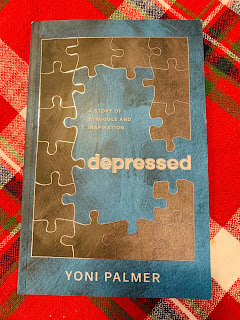
Depressed--a different take on depression, a Jewish point of view

Depressed-by Yoni Palmer, Mosaic Press

 Depressed--a different take on depression, a Jewish point of view.

Well, it isn't so different, not if you are a Jewish, observant psychotherapist, but it is a lovely little book, even wonderful, emphasizing among other things the need (for some of us) to procreate and how devastating it can be when we fail.

If you're a little bit knowledgable of Tanach, those books that follow the Five Books of Moses, you will recognize some of Yoni Palmer's references, especially the story of King Saul in the Book of Samuel (Samuel I). You'll remember noticing, even in that very first reading years ago, that Israel's first king suffered an Axis I disorder--bad. Saul's courtiers did what they could to cheer him up, even brought in a local musician, David. Later the king would chase after David in a paranoid effort to kill him, ultimately killing himself. So out of sorts puts it mildly when we speak of King Shaul.

Anyway.

More of the back story than anyone needs to read. We went to Israel a few weeks ago, had tried to get in much earlier during the pandemic but the country shut its borders to us, fearing contagion would have none of our bringing the disease to Israel. But now that everyone in this tiny country has had covid or been exposed, and many are vaccinated times four, they opened up. And when they did I jumped on a direct flight, ticketed immediately. This before Omicron inserted its viral head into the Israeli calculus. Once the variant took hold the Ministry of Health made people wish they hadn't wanted to return to the homeland--so many hoops to jump through to fly. Then that return flight to the US and a stop in Newark to deplane, retrieve bags, go throught passport control and customs, recheck bags, security again. Why they had to cancel that direct flight no one knows. (Hey, a blog is for venting, am I right?)

It just so happened that our trip coincided with a dedication of stained glass windows in a synagogue. The windows, each depicting a female Jewish heroine, are dedicated to my dear sister-in-law, her memory should be a blessing. She passed away a year ago after a valiant struggle with 4 or 5 different types of cancers. Damn that disease. There, I said it.

At the dedication a favorite cousin of ours handed me a book. Depressed. That's the title. I automatically recoiled. I tend to read either fluffy, funny things, non-fiction (am deep into the Vietnam War right now), or well-written novels. (Sure, sure, I read about neopronouns, too). If a story is about a culture I'm not familiar with, like Native Americans, or people from Asia or Africa, I'll read it cover to cover. These are inevitably sad, but worth the trip.

So when Yoni Palmer hands me a very slim paperback about depression published by Mosaic Press, inside I groan. I feel bad for groaning and hope I am not showing the groan, but in my home there are two full shelves of books on depression, bipolar disorder, and suicide prevention. At least this treatment is light, only 95 pages and will fit right in. 

I read Depressed in one sitting, most pleasantly surprised. It is raw, personal, and insightful. When I ask Yoni what he is doing these days he unapologetically tells me, 'I'm a writer.' How many of us have the guts to say that? I think he also has a day job. 

What I like about his story is not so much his struggle with depression--I've heard twenty thousand of these first hand, I wish this were an exaggeration but people do seek help and they do get better, thank GD. It is Yoni's research into the Talmudic treatment of depression that keeps me in the game. He searches for the 'Jewish take' on the disorder and he finds it. 

I'll sum up that Jewish take with two words: Depression is.

Rather than ignore it or consider depression a weakness or character failure, even some sign of lack of faith, Judaism accepts it--always has. Many say that when we accept what we're feeling, the weight, the burden lightens just a little bit, a sliver. But a sliver, perhaps a shot of serotonin, is good! If we don't accept something we are likely judging it negatively and judging one's self negatively hurts, and it takes a lot of psychic energy--way too much time and energy. This could be one of the reasons depression is so exhausting. Coping with how others judge us, too, takes valuable emotional resources, too much ram. Better to float, sleep, rest, not think. Medicate for awhile. Go to therapy.

You can find Yoni's book here

Winter's almost over friends. Not that we're judging winter, we couldn't possibly diss all that white, black and gray that we see if we look out the window. No, we're good. Right?

P.S. My daughter just sent me this wonderful opinion piece in the Jerusalem Post by Harold Goldmeier, another take on not judging: Jews and suicide

therapydoc


Transitions

   Rabbi Zev o nce  told us that a rabbi, a Jew, has to be ready to go to a funeral and then a wedding  on the same day, maybe within a few ...